
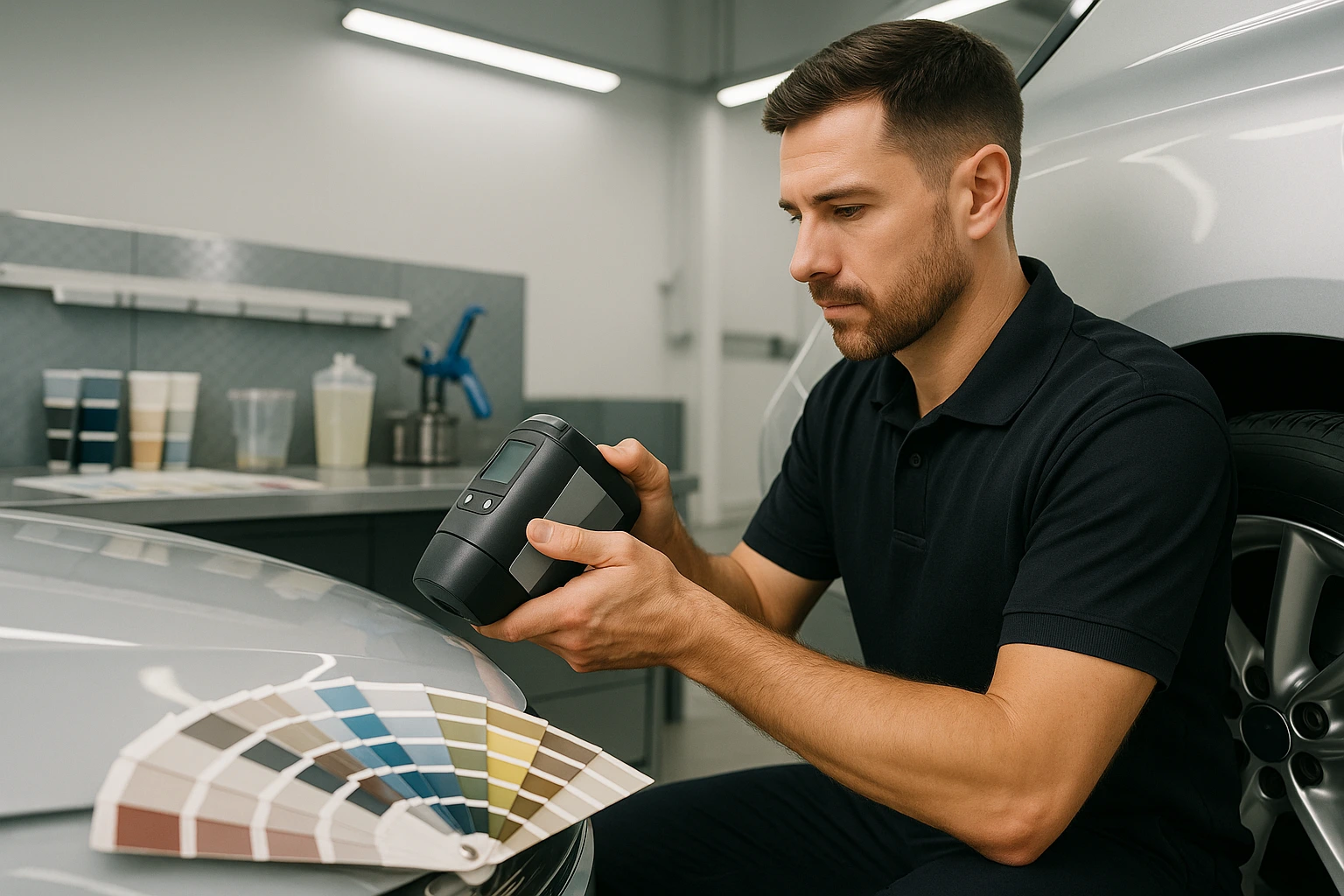
Color Matching Techniques for Paint and Body Repair is both a science and an art. When done correctly, it restores your vehicle with factory-fresh precision—ensuring the repaired area blends seamlessly, protects your car’s value, and delivers long-lasting, flawless results.
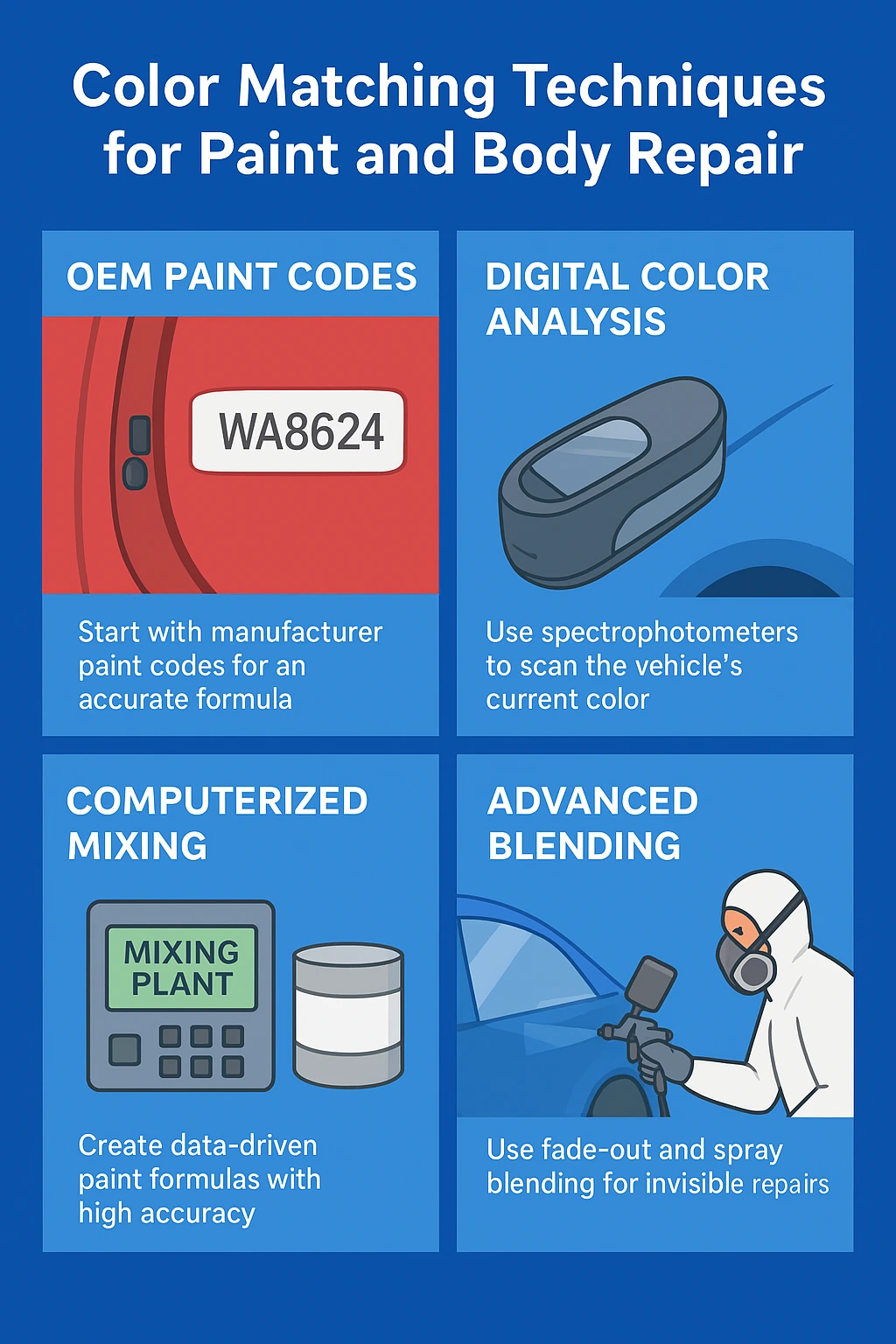
- Start with OEM paint codes to get an accurate formula, but always verify against the vehicle’s current color, as sun, age, and manufacturer variations can shift the original shade over time.
- Leverage digital color analysis using spectrophotometers for objective, real-world scans—this tech captures subtle shifts caused by weather and exposure for true-to-life matches.
- Rely on computerized mixing systems for data-driven paint formulas that deliver up to 95%+ matching accuracy and minimize costly rework or waste.
- Demand real-world application testing—professional shops always use test panels and visual checks under multiple lights to ensure a repair is truly invisible from every angle.
- Insist on advanced blending techniques like fade-outs and spray blending, especially for metallics or pearls, to erase repair boundaries and maintain showroom quality.
- Trust skilled technicians for manual tinting and adjustments, as over 60% of flawless matches require expert human intervention beyond automated methods.
- Account for finish types and environmental control; proper handling of single-stage, base/clear, or specialty paints, along with climate-managed application, ensures maximum color accuracy and durability.
- Choose a shop that prioritizes transparency, quality checks, and customer care to guarantee a repair that’s not just “good enough” but indistinguishable from the original.
For repairs that disappear and craftsmanship you can trust, explore the full guide—your vehicle deserves nothing less than expert auto repair and trusted service.
Introduction
Imagine picking up your car after a repair—and staring in disbelief, because you simply can’t tell which panel was painted.
For vehicle owners, few things are more frustrating than a “fixed” fender that screams with mismatched color in broad Texas sunlight.
At Auto Clinique, we know that even a tiny shade difference can turn a seamless repair into an obvious patch job.
That’s why precise color matching isn’t just a bonus—it’s essential to maintaining your car’s value, appeal, and your peace of mind.
But here’s what most drivers don’t realize: paint color matching is both a science and an art, influenced by factors you might not expect—like sun-fade, manufacturer variations, and even the Dallas climate.
Over 28% of repainted vehicles require expert adjustments, because relying on a basic paint code almost never guarantees a perfect finish.
So, how do top shops achieve repairs that are truly “invisible”?
You’ll discover:
- The industry-leading digital tools that capture your car’s exact, current color
- Why blending and manual tinting by skilled technicians make all the difference
- How rigorous real-world testing—under sunlight and shop lights—ensures your car looks flawless from every angle
On the surface, auto paint matching seems straightforward. In reality, it’s a blend of technology, hands-on expertise, and dedication to quality—because every car and every repair tells a unique story.
Auto Clinique’s promise of Expert Auto Repair, Trusted Service lives in the details: honest pricing, customer-first care, and repairs that exceed expectations.
Ready to see how professional color matching transforms your auto repair experience?
Let’s explore the fundamentals behind every “factory-perfect” finish—and uncover what separates a truly professional repair from everything else on the road.
The Fundamentals of Automotive Color Matching
Color matching is the science and art of ensuring new paint blends seamlessly with a vehicle’s original finish after repairs.
It’s not just about picking a color; it’s about creating a result that’s virtually undetectable—even in direct sunlight or under harsh garage lights.
Why Exact Color Matching Matters
A perfect color match is what separates a professional repair from an obvious patch job.
- Seamless color matching maintains the car’s value and appearance
- It helps prevent frustrated returns or costly rework
- At Auto Clinique, it’s a core part of our promise: “Expert Auto Repair, Trusted Service”
Picture this: you step out of your car after a minor fender bender repair—the panel looks so flawless, even you can’t tell which side was painted.
Common Color Matching Challenges
Achieving this invisible result isn’t simple—three main hurdles can get in the way:
- Paint aging: Sunlight, weather, and even car washes fade the original color over time
- Environmental exposure: Humidity, smog, and road salts cause subtle shifts in shade or gloss
- Manufacturer variations: OEM paint batches differ, making the “right” code just a starting point
A 2017 industry survey found that nearly 28% of repainted vehicles required manual tinting or blending, due to these challenges.
Building Trust Through Precision
Getting the color right means more:
- It upholds Auto Clinique’s commitment to quality—repairs that “stand the test of time”
- Customer trust relies on transparency; no surprises, just honest work
- Every detail matters: from accurate estimates to the final paint finish
When repairs vanish and panels look factory-fresh, customers know they chose professionals who care.
Delivering on Our Promise
Great color matching is both a technical process and a reflection of our values.
At Auto Clinique, we use advanced tech and real-world skills to make sure your repair doesn’t just meet expectations—it exceeds them.
Key takeaway: “Invisible repairs require more than the right code—they demand an expert eye, the right tools, and a promise to treat every car like it’s our own.”
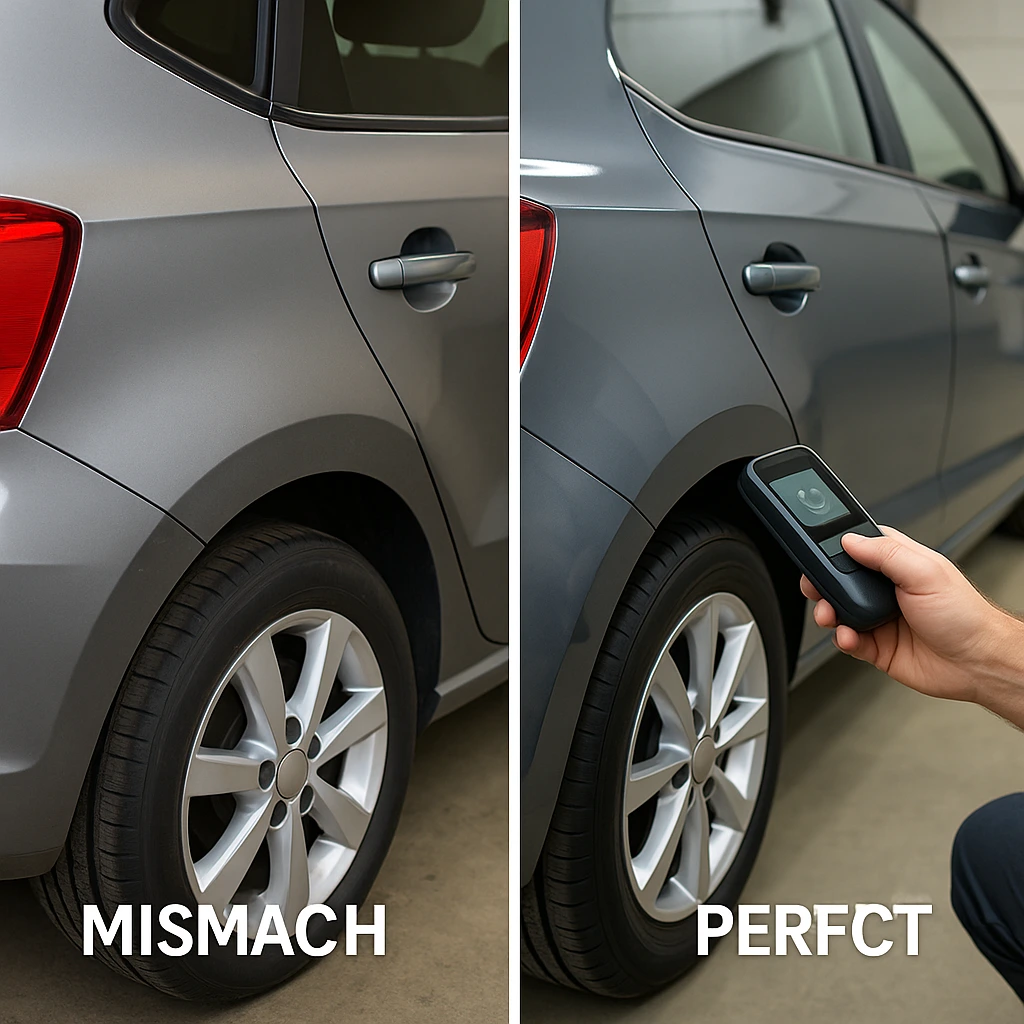
Manufacturer Paint Codes and OEM Data
What OEM Paint Codes Are—and Where to Find Them
OEM paint codes are unique identifiers assigned by the vehicle manufacturer to specify the exact shade and formula used on each vehicle.
You’ll typically find these codes on a sticker or metal plate in locations such as:
- The door jamb (driver’s side)
- The VIN plate under the hood or near the windshield
- The glove box or trunk lid
For most makes and models, the paint code will be a mix of letters and numbers (like “WA8624” for GM or “NH-731P” for Honda).
Quotable: “A single string of characters on your door jamb holds the secret to your car’s showroom shine.”
How Paint Codes Connect to Manufacturer Databases
Once located, your technician enters the paint code into a manufacturer color database, instantly retrieving:
- The original paint formula
- Recommended mix ratios and base pigments
- Specific application guidance for that paint system
These databases create a powerful starting point, simplifying the process for routine and factory-original repairs.
Picture this: A tech scans your VIN, pulls up the code, and the computer auto-generates the formula—speeding up prep.
Where Paint Codes Fall Short
However, paint naturally ages—sun, weather, and even factory variations influence color over time.
Common reasons OEM codes don’t give an exact match include:
- Fading: Texas sun can shift reds, blues, and blacks by several shades in 2-4 years.
- Batch inconsistencies: Subtle differences from the original paint batch.
- Previous repairs: Unrecorded blending or aftermarket paints.
If a 2017 sedan comes in with minor bumper damage, the OEM code might produce a new paint that’s slightly brighter than the surrounding panels—making the repair stand out instead of disappear.
Quotable: “The code is the recipe, but the cake doesn’t always look the same after years in the sun.”
Integrating Paint Codes with Modern Color Matching
At Auto Clinique, our approach goes beyond the code. We combine OEM formulas with advanced digital spectrophotometry for best-in-class matches.
That means every job starts with the right formula and then adapts—ensuring your repair flows seamlessly from old panels to new.
Key takeaways: Always start with the code and verify—never paint blind. OEM data is your foundation, not your finish line.
For the best repairs in Dallas, accuracy comes from both information and adaptation—because every car’s story is unique.
Digital Color Analysis: Spectrophotometers and Software
Spectrophotometers are transforming how auto body shops achieve the perfect color match after a repair.
When a vehicle arrives, technicians use these handheld devices to scan the car’s paint directly—no guesswork, just clean, objective data.
Step-by-Step Paint Scanning Process
A typical digital color analysis involves:
- Placing the spectrophotometer on a flat area of the car’s undamaged paint
- Scanning the paint surface to record how light reacts with the unique pigments
- Collecting detailed data including hue, value, and chroma
- Uploading readings instantly to color-matching software
This process takes just a few minutes, providing a starting point far more accurate than eyeballing or using only manufacturer codes.
How Digital Analysis Corrects for Real-World Paint Changes
Every car’s paint changes over time—sun exposure, weather, and age all play a role.
Digital scanning doesn’t just capture the original color; it documents the “as-is” shade, including:
- Faded or oxidized finishes
- Areas affected by regular use or minor scratches
- Subtle differences between panels caused by sun and environment
With more than 80% of modern repairs involving some paint aging or variation, these tools help bridge the gap between formula and reality.
Inside the Shop: Color-Matching Software Integration
After scanning, results are matched with massive manufacturer databases via specialized software.
Here’s how systems typically work:
- Input scan data from the spectrophotometer
- Match to OEM and custom formulas
- Generate precise mixing instructions for paint shop equipment
- Allow for expert adjustment by presenting subtle tinting suggestions based on lighting and angle feedback
Leading brands like PPG, Axalta, and BASF offer platforms that interface with spray booths and mixing stations, boosting efficiency and minimizing error.
Real-World Example: Tackling Complex Metallic Paints
Picture this: A Dallas customer brings in a pearl white SUV that’s seen five hot Texas summers.
The spectrophotometer identifies a subtle gold shift—imperceptible to the naked eye, but immediately caught by the digital scan.
The result?
- Custom-mixed paint that accounts for the faded undertone
- Seamless repair that’s indistinguishable from the rest of the car
- Delighted customer who can’t spot the difference, even up close
Digital color analysis brings science, speed, and unmatched accuracy to paint matching—making today’s repairs more reliable, repeatable, and visually flawless. If you want results you can trust, this technology is the gold standard for invisible repairs and true customer satisfaction.
Computerized Mixing and Paint Formulation
Computerized mixing is the heart of modern color matching in automotive paint repair.
These systems move beyond basic paint codes—using precise, data-driven formulas to create paint that visually disappears into the car’s original finish.
The Shift: From Paint Codes to Digital Precision
Traditional repairs started with the OEM paint code, but even a perfect match on paper can fall short in real-world conditions like fading or weather exposure.
Today’s repair shops rely on:
- Digital color analysis from spectrophotometers
- Software-integrated mixing systems
- Proprietary color databases regularly updated with manufacturer specs
“A perfectly coded color isn’t always a perfect match. That’s why data-driven mixing leads the way.”
Inside Computerized Mixing: How It Works
Picture this: a technician scans your car’s paint, capturing hundreds of color data points—hue, shade, and even reflective qualities.
That data is fed into a computerized mixing station, which:
- Calculates the ideal pigment mix and ratios
- Dispenses precise amounts of each toner (often down to 0.01 grams)
- Recommends adjustments based on substrate or finish type
Benefits instantly noticeable:
- 95%+ matching accuracy even on older or faded vehicles
- Reduced waste and minimized costly rework
- Consistent results for every car, from sedans to classic restorations
Manual Tinting: The Human Touch in Color Science
No system is foolproof—sometimes, lighting shifts or a unique finish means the first pass isn’t perfect.
That’s where expert technicians step in with:
- Manual tinting (adding a drop of blue, dash of yellow, etc.)
- On-the-spot adjustments guided by both the eye and experience
- Test sprays on panels to compare, correct, and sign off
“Computerized matching gets you close; a craftsman’s eye delivers perfection.”
Quality Assurance at the Mixing Stage
Every paint batch undergoes a multi-point check before hitting the car, ensuring:
- Color accuracy under different lights and angles
- Mix stability for application
- Consistent texture and blending properties
Shops confirm matches with a visual inspection, often backed by digital readings and customer review—eliminating surprises at delivery.
The result: every color match combines science, artistry, and care, all rooted in a process built for trust and transparency.
A reliable, precise matching process means your car’s repair is virtually invisible—and you drive away with confidence in a job done right.
Application Testing: Panels and Visual Checks
Why Real-World Testing Is Non-Negotiable
Before any paint touches your car’s main panels, real-world application testing is standard practice at Auto Clinique.
A paint match might look perfect in a database or on a digital screen—but vehicles interact with sunlight, shadows, and angles in ways that software simply can’t predict.
A professional shop will always conduct application sampling to prevent costly or noticeable mismatches.
“A perfect blend on a test panel saves hours of rework and ensures you drive away with pride, not disappointment.”
How Test Panels and Vehicle Areas Are Used
Technicians apply the mixed paint to:
- Test panels—small, flat surfaces kept in the shop for controlled sample spraying
- Inconspicuous areas—edges of doors, under trunk lids, or wheel wells, where spray-outs can be examined discreetly
These samples are compared directly against the vehicle’s original paint, giving a side-by-side color reference.
This crucial phase captures what a digital scan might miss—such as subtle metallic effects or aging-related color shifts.
Lighting, Angles, and Visual Validation Protocols
Color accuracy can change under different conditions, so trained eyes check samples in:
- Natural daylight
- Indoor fluorescent and LED shop lighting
- Sharp angles and straight-on views
This thorough approach ensures a paint match that’s invisible at any time of day —a key standard for customer satisfaction and shop credibility.
“Lighting transforms a color match; what looks seamless under shop lights might stand out in the Texas sun.”
Adjusting Formulas and Making the Final Call
If there’s even a slight discrepancy, expert technicians spring into action:
- Tinting—adding precise amounts of pigment to refine the hue or depth
- Reformulation—mixing a new batch based on observed nuances
- Approval or rejection—a match is only approved if it’s flawless from every viewing position
Paint shops average at least two test iterations before achieving final approval—a testament to the detail involved.
What This Means for Your Repair
Picture this: a technician holding a freshly painted test panel up to your vehicle, inspecting closely under the Dallas sky, ensuring that the match is truly undetectable.
Every approved paint repair at Auto Clinique is the result of methodical sampling, visual validation, and expert adjustment—so you can trust that your car’s finish is seamless, every time.
For the most natural, factory-like repair, always choose a shop that values meticulous application testing and gives you transparency at every stage.
Advanced Blending and Fading Techniques
Achieving an invisible repair means blending new paint perfectly with old, especially on metallic or pearl finishes.
Blending goes far beyond simple repainting—it’s about erasing the boundary where old meets new so the repair vanishes from view.
A mismatched panel can drop resale value by up to 15%, making seamless blends a must-have standard for quality repairs.
Essential Blending Methods
Professionals rely on several specialized methods, each designed to smooth transitions and control sparkle or color change:
- Fade-out: Gently reduces color strength at the edge of the repair to merge old and new paint.
- Spray blending: Light, overlapping passes feather color evenly into adjacent areas for a soft, gradual transition.
- Drop coats: A fine mist pass—often used for metallics and pearls—to orient flakes consistently and control light reflection.
Picture this: metallic silver on a car door—hard edges show every flaw. A fade-out and two strategic drop coats let sun and streetlight bounce from the paint in the same way across the entire side, making the repair truly invisible.
Step-by-Step Blending for Flawless Results
- Preparation: Clean, sand, and mask the area; ensure dust-free surfaces.
- Spraying: Apply color in controlled, overlapping coats, gradually reducing toward the blend edge.
- Feathering: Lightly extend the blend zone with decreasing paint volume for a natural fade.
- Inspection: Evaluate under multiple light sources (sunlight, LED, shop lights) to catch shifts in hue or sparkle.
Each step is about precision—it’s the difference between an okay repair and expert-level work.
Overcoming Panel and Color Challenges
Blending is vital when:
- Matching adjacent panels that may have faded differently from sun or age.
- Panels have complex finishes—metallics or pearls shift color depending on the angle, so precise blending and flake alignment matter.
A single panel repair that skips blending is almost always obvious—especially on white metallic or deep reds, which are notorious for visible “patch jobs.”
When done right, blending transforms repairs from “noticeable fix” to “showroom quality.” As we say, great blends make repairs invisible—the ultimate standard for expert auto body work.
Whether you’re facing a simple spot repair or a complex pearl finish, the secret to professional results is flawless, patient blending—making your vehicle look untouched, every time.
Expert Visual Adjustment and Custom Matching
Even with today’s high-tech paint scanners, some color matches still demand a human touch. When technology reaches its limits, it’s the expert’s trained eye and steady hand that make seamless repairs possible.
Some vehicles—especially older models or custom paint jobs—have finishes that standard codes and scanners simply can’t replicate. Years of sunlight, weather, and cleaning can shift the original color into new territory. This is where visual inspection and hand tinting come into play.
The Craftsman’s Eye: When Only Experience Counts
Imagine an auto technician comparing paint samples under bright shop lights, then stepping outside to check the color in direct Texas sun. Matching a faded 2006 red or a custom pearl blue isn’t just about formulas—it’s about perception.
Key steps experts use when scientific tools fall short:
- Visual inspection under multiple light sources (shop, daylight, shade)
- Hand-mixing tints, adding pigments in tiny amounts until the hue is just right
- Testing small batches on “test cards” or scrap panels for validation
In these moments, the craftsman’s experience becomes the difference between a visible fix and an invisible repair.
Matching Custom and Highly Faded Finishes
Off-the-shelf matches often fail for vehicles with heavily weathered or unique finishes. For these challenging cases, technicians:
- Use physical samples—like removing a fuel door or trim piece—to create an off-car reference
- Mix micro-adjustments to tone, depth, or flake, relying on years of hands-on practice
- Rely on pattern recognition and memory honed through hundreds of matches
This process can be time-intensive, sometimes requiring several attempts and adjustments to reach perfection.
Why Skilled Technicians Make All the Difference
Training and experience aren’t just buzzwords—they’re essential. According to industry reports, over 60% of flawless color matches involve manual adjustments beyond automated methods.
At Auto Clinique, our technicians undergo ongoing training to:
- Master the nuances of visual color matching
- Identify the subtle undertones caused by age or environmental exposure
- Deliver results that “disappear” repairs into the rest of your car
Picture this: A technician, brush in hand, comparing a wet spray-out with the original panel until the transition line is impossible to find. That’s the art—blending science and craftsmanship for truly expert results.
Skilled experts ensure that, even when digital tools aren’t enough, your finish is undetectable. The key takeaway? True color matching is both a science and an art—your vehicle deserves both.
Additional Factors Influencing Color Match Accuracy
Finish Types and Paint System Considerations
Paint matching isn’t one-size-fits-all—the finish type changes everything.
Auto paints usually fall into three main categories:
- Single-stage systems, where color and gloss come in one coat
- Two-stage (basecoat/clearcoat) finishes, involving a colored base under a glossy clear layer
- Specialty and custom finishes, such as metallics, pearls, or matte coats
Each system demands unique handling:
- Single-stage: The color seen is the only surface visible—perfect matching is critical, and there’s less room for error.
- Two-stage: Color comes from the base, while depth and shine are created by the clearcoat, so the clear’s thickness and type impact how the color appears.
- Specialty finishes: Pearls, candy colors, or metallics need advanced flake orientation and multiple steps—picture the play of light on a freshly waxed car, and imagine matching that perfectly.
“Matching a metallic finish in the Texas sun is a true test of skill—flakes must lay just right to look invisible up close and from across the parking lot.”
Environmental and Application Variables
Even the best color formula can fail unless environmental conditions are managed.
Variables that impact color accuracy include:
- Temperature and humidity in the shop
- Spray equipment calibration (pressure, nozzle size, and pattern)
- Dust and airborne contaminants
Modern shops control these by:
- Testing spray patterns daily and cleaning equipment carefully
- Using climate-controlled spray booths to keep conditions steady year-round
- Pausing paint application if weather shifts rapidly (in Dallas, that can mean halting operations for a summer pop-up storm)
“A paint match that looks perfect indoors may shift dramatically in sunlight if temperature or spray pressure drift just a bit during the job.”
Quality Control and Post-Repair Verification
Multi-step quality checks are the final guardrail for your satisfaction.
Professional protocols include:
- Inspecting paint under daylight, LED, and soft indoor lighting for color agreement
- Using a checklist to spot-check blends, edges, and transition zones
- Taking photos or using digital color charts for documentation
Afterward, shops will:
- Share before-and-after images with clients
- Clearly explain any blending or color matching choices made
- Provide written records for insurance or future reference
“At Auto Clinique, we do more than match paint; we match your expectations through transparency, documentation, and consistent follow-up.”
Whether you’ve got a basic touch-up or a full-panel refinish, understanding finish type, controlling the environment, and demanding thorough post-repair checks ensures the most accurate color match possible. Aim for a repair that’s invisible under any light—and confidence every time you step back to admire your vehicle.
Comparative Overview of Main Color Matching Methods
Getting a seamless finish after auto body repair isn’t luck—it’s science, skill, and the right choice of color matching method.
In the modern repair shop, five core techniques shape color match outcomes:
- Paint Code Matching: Using OEM paint codes and manufacturer databases for a baseline formula.
- Digital Analysis (Spectrophotometry): Scanning paint with specialized tools to capture current color shifts.
- Test Panel Application: Spraying mixed paint on sample panels for visual comparison.
- Hand Matching/Tinting: Manual pigment adjustment by a skilled technician for unique or aged colors.
- Blending Techniques: Spraying and feathering to fade new paint into adjacent panels for an invisible edge.
Key Benefits and Limitations
Not all methods work for every repair scenario. Here’s how they stack up for quality results:
- OEM Paint Code
- Pro: Fast and precise for newer vehicles.
- Con: Less accurate for faded paint due to age or sun exposure.
- Spectrophotometry
- Pro: Delivers a data-driven match, adjusting for real-world color changes.
- Con: May still struggle with extreme oxidation or custom finishes.
- Test Panels
- Pro: Validates the match in real lighting; highly visual.
- Con: Can add 20–30 minutes per step; sometimes requires multiple attempts.
- Hand Tinting
- Pro: Essential for vintage, custom, or severely faded vehicles.
- Con: Dependent on technician expertise—“getting it right” is an art.
- Blending
- Pro: Hides near-invisible differences, especially with metallics or pearls.
- Con: Not suitable for isolated panel repairs where edges aren’t blended.
Choosing the Right Match Method
Selecting the right technique means looking at:
- Vehicle Age: Newer cars work best with paint codes; older cars often need digital matching or hand tinting.
- Paint Type: Two-stage (base/clear) and specialty finishes require more advanced blends.
- Damage Scope: Small panel repairs might allow for direct match; larger areas almost always benefit from blending techniques.
At Auto Clinique, we ensure every match meets our quality, transparency, and customer-first standards—there’s no guesswork, only expertise.
Shareable Insights and Visual Moments
- “A perfect paint match is equal parts formula, technology, and craftsmanship.”
- “Picture this: a sun-faded hood matched perfectly, even in bright Dallas sunlight.”
- “Matching metallics takes more than a code—blending and a technician’s trained eye are key.”
A successful, invisible repair relies on selecting—and combining—the right methods for the job. For every vehicle and every finish, expertise drives confidence.
For technical insights into automotive paint systems, visit the PPG Refinish Technology Center.
Conclusion
A flawless color match isn’t just a detail—it’s the difference between a repair you notice every day and one that restores your confidence every time you walk up to your car.
When you choose advanced color matching, you protect your vehicle’s value and enjoy a seamless, factory-fresh finish that speaks to true craftsmanship.
—
Key Takeaways
- Insist on digital color analysis and blending—these deliver invisible repairs, not just a close approximation.
- Always verify your paint code but remember: expert technicians go beyond the code for real-world results.
- Request test panels and visual checks—great shops will validate the match under multiple lighting conditions before finishing your repair.
- Choose repair professionals who combine high-tech tools with hands-on skill—especially for faded, metallic, or custom finishes.
—
Immediate Next Steps
- Ask your auto repair shop about their color-matching process—transparency means quality and trust.
- Request to see test panels or color samples before final application, so you know the match is perfect.
- Share your repair expectations clearly—a great shop will welcome your questions and walk you through their process.
—
Only the most meticulous color matching delivers results you can count on year after year.
When expertise, integrity, and innovation meet, your car receives a repair that’s as invisible as it is reliable. That’s the Auto Clinique promise—and the standard you should expect every time.
Perfect paint is never by accident. Drive away with confidence, knowing every detail has been restored the right way.
For seamless repairs beyond paint matching, explore our Auto Body Repair Services
FAQs
1. What are Color Matching Techniques for Paint and Body Repair?
Color Matching Techniques for Paint and Body Repair are specialized methods used to recreate a vehicle’s factory paint color through digital scanning, OEM codes, tint adjustments, and expert blending.
2. Why are Color Matching Techniques important in auto body repair?
They ensure the repaired area blends seamlessly with the original paint, preventing noticeable differences that can reduce your vehicle’s appearance and resale value.
3. How do technicians match the exact color of my car?
Professionals use spectrophotometers, OEM paint formulas, controlled lighting, and panel blending to achieve an accurate match.
4. Can Color Matching Techniques match faded or aged paint?
Yes. Advanced color matching techniques allow technicians to adjust formulas to mirror UV-faded, oxidized, or aged paint for a natural transition.
5. What role does blending play in Color Matching Techniques for Paint and Body Repair?
Blending feathers new paint into adjacent panels, making the transition invisible and ensuring an exact visual match under all lighting conditions.
6. Are digital color scanners accurate for paint matching?
Modern scanners are highly accurate and help technicians identify micro-variations in your vehicle’s paint. However, final tinting and blending still rely on expert skill.
7. How long do Color Matching Techniques take?
Depending on repair size, blending needs, and curing time, color matching and refinishing typically take 1–3 days.
8. Do Color Matching Techniques differ between metallic and solid paints?
Yes. Metallic and pearl paints require specialized spray patterns, flake orientation control, and advanced blending to ensure uniform reflection and depth.
9. Can I achieve professional results with DIY color matching?
DIY kits rarely provide the precision needed. Professional-grade tools, controlled environments, and trained technique are key to invisible repairs.
10. How do I choose the best shop for Color Matching Techniques for Paint and Body Repair?
Look for:
-
Certified technicians
-
Digital color-matching systems
-
Strong before/after photos
-
Warranties on paint and workmanship