

30-60-90 Rule for Cars Dallas is one of the smartest preventive maintenance strategies for extending your vehicle’s lifespan, reducing unexpected repair costs, and improving reliability on Dallas roads. Whether you drive a new sedan, SUV, truck, or hybrid, following the 30-60-90 Car Maintenance Schedule helps keep your vehicle performing at its best while protecting its long-term value.
Here are the most important insights to empower your next maintenance decision:
- The 30-60-90 rule sets major service milestones at 30,000, 60,000, and 90,000 miles to proactively address wear and keep your car in top condition.
- Scheduled maintenance catches early issues, helping you avoid expensive breakdowns and spread out repair costs more predictably.
- Each service interval adds essential checks, from basic oil changes at 30k to spark plug replacement at 60k and timing belt inspection at 90k, tailoring care as your car ages.
- Adhering to this rule can boost resale value by up to 10% and is often required to maintain factory warranty protection.
- Customizing intervals for your make, model, and Dallas driving conditions ensures your vehicle receives exactly what it needs—no more, no less.
- Missed a milestone? Prioritize a basic checkup, get a full inspection, and start tracking service records to restore peace of mind.
- Newer cars with advanced tech—like hybrids and EVs—may have different schedules; use your owner’s manual and digital reminders for the most reliable guidance.
- Trusted shops like Auto Clinique deliver transparent, personalized service, so you only pay for quality repairs that stand the test of time.
Take these steps to transform maintenance into a stress-free routine—investing a little now ensures thousands of miles of worry-free driving ahead. For all the details and practical advice, dive into the full article above.
Introduction
Ever wondered why some cars quietly hit 200,000 miles while others seem to break down at the worst possible moment?
For Dallas drivers, the difference often comes down to one simple practice: following a mileage-based maintenance plan that catches problems before they become costly surprises.
The 30-60-90 rule is your car’s personalized blueprint for longevity—a straightforward, easy-to-remember system that helps you avoid unexpected repair bills and ensures your ride is always ready, no matter how unpredictable Texas roads get.
Imagine showing up at the shop and knowing exactly what your vehicle needs, instead of bracing for a long list of “unknowns.” That kind of transparency not only protects your wallet, but also gives you the peace of mind that comes with expert, honest care.
- Longer vehicle life and higher resale value
- Fewer breakdowns or emergency repairs
- Predictable, honest maintenance costs
Today’s cars are smarter and more durable, but routine checkups—especially at key milestones—are still the top strategy for getting the most from every mile.
Whether you just bought a new car, want to protect your warranty, or simply enjoy the confidence of a reliable commute, understanding how the 30-60-90 maintenance schedule fits your car and driving habits is the smartest move you can make.
Next, we’ll break down what the 30-60-90 rule really means, and how this time-tested approach keeps Dallas drivers on the road—and out of the repair shop.
Understanding the 30-60-90 Rule for Cars dallas: Foundations and Purpose
The 30-60-90 rule for cars offers a clear, mileage-based roadmap to keep your vehicle running at its best.
Think of it as a check-in schedule—major maintenance services are recommended at 30,000, 60,000, and 90,000 miles.
This system helps car owners avoid costly surprises and enjoy a more reliable ride.
While the 30-60-90 Rule for Cars Dallas provides an excellent preventive maintenance framework, every vehicle has unique service requirements. Always compare your maintenance schedule with your vehicle owner’s manual maintenance schedule to ensure recommended inspections and replacement intervals match your make, model, engine, and driving conditions. Manufacturer maintenance schedules remain the best source for warranty protection and long-term reliability.
Why Does the 30-60-90 Rule Exist?
Manufacturers and expert mechanics noticed that certain car parts and systems naturally degrade over time and use.
Instead of waiting until there’s a problem, the 30-60-90 rule encourages:
- Regularly scheduled inspections and part replacements
- Catching early signs of wear before they become failures
- Spreading out maintenance costs instead of facing one big repair bill
Following this system prevents the “fix it only when it breaks” trap—a common cause of high repair bills.
What the Rule Is—And What It Isn’t
It’s important to remember: the 30-60-90 rule is a trusted guide, not a replacement for your owner’s manual.
Actual services for each checkpoint—such as oil changes, filter replacements, or brake checks—vary by:
- Make and model
- Engine type
- How and where you drive (for example, Dallas heat and city traffic call for extra attention)
Always double-check your vehicle’s specific recommendations in the manual.
Who Gets the Most Value from This Rule?
You’ll especially benefit from this approach if you:
- Just bought a new car and want it to last
- Care about dependability and warranty coverage
- Prefer predictable, transparent maintenance (no surprise expenses)
“Picture this: You stick to the 30-60-90 schedule, and your car earns a reputation for never leaving you stranded.” This peace of mind is what keeps many Dallas drivers loyal to the rule.
Long-Term Benefits at a Glance
By following the 30-60-90 rule, you set your car up for:
- Longer life and higher resale value
- Fewer breakdowns and emergency repairs
- Easier budgeting with fewer surprise costs
This simple, proactive maintenance habit transforms how you care for your vehicle—saving money, reducing worry, and delivering true confidence behind the wheel.
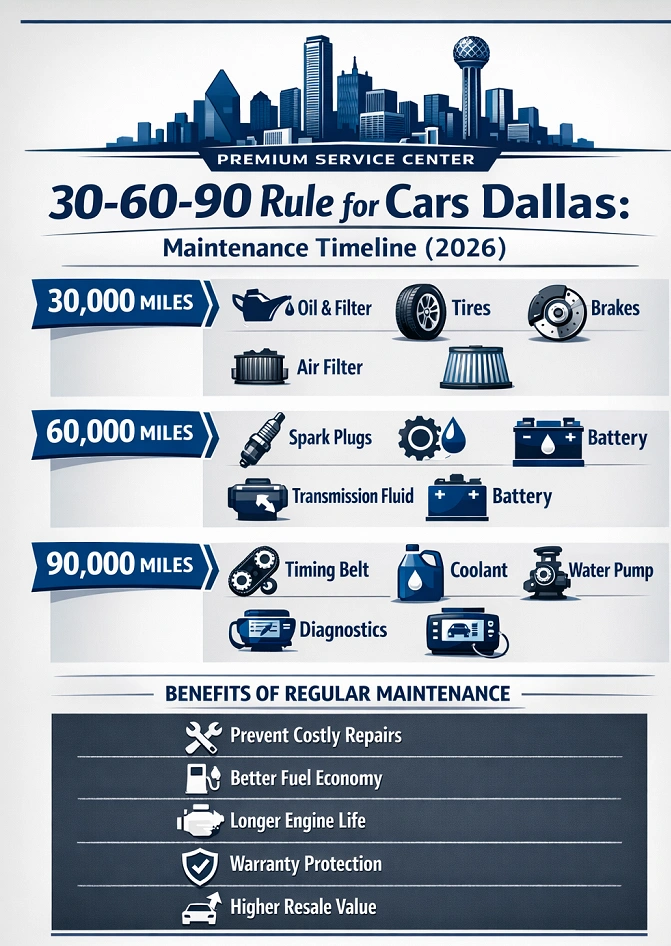
What Happens at Each 30-60-90 Maintenance Interval
30-60-90 Rule for Cars Dallas helps drivers understand exactly what should be inspected, serviced, and replaced at each major mileage milestone, making it easier to prevent expensive repairs, improve reliability, and keep vehicles performing at their best on Dallas roads.
30,000-Mile Service: First Major Checkpoint
At 30,000 miles, your vehicle hits its first major maintenance milestone—think of this as a health checkup for your car’s essential systems.
Key services include:
- Oil and filter change
- Tire rotation
- Brake inspection
- Fluid level and condition checks (coolant, brake, transmission, power steering, windshield washer)
- Air filter inspection/replacement
- Belt and hose inspection
These services are designed for early wear detection, helping catch minor issues before they become expensive headaches.
Picture this: a quick visit for a 30k service could prevent an unexpected roadside stop months later.
Expect to invest about 1-2 hours and, in the Dallas area, pay between $150–$300 depending on your car’s make and model.
Want to see what’s typically included? Check out our detailed guide: Routine Maintenance: What’s Included?
“Your car’s first 30k service is peace of mind, bottled up and delivered on schedule.”
—
60,000-Mile Service: Attention to Aging Components
By 60,000 miles, components start to show real signs of aging—this is where deeper attention pays off.
Main services include:
- All previous 30k checks plus:
- Spark plug replacement (on most vehicles)
- Transmission fluid service
- Deeper brake assessment
- Battery health check
- Suspension and steering inspection
- Additional belt and hose scrutiny
At this checkpoint, you’re tackling parts more prone to wear with mileage—skipping it risks surprise downtime and bigger repair bills.
A 60k service often runs $350–$700 in Dallas, reflecting its more comprehensive nature and increased parts/labor.
Explore the details in Transmission Maintenance & Fluid Service for insights on this crucial interval.
“A well-timed 60k service is the difference between a dependable ride and a sudden breakdown.”
—
90,000-Mile Service: Preparing for the Long Haul
The 90,000-mile interval is like prepping your vehicle for the next major chapter—here, comprehensive checks and replacements keep you road-ready.
Critical services typically cover:
- Repeat 30k/60k checks
- Coolant flush/replacement
- Timing belt and water pump replacement (if required by manufacturer)
- Deep inspection of battery, drivetrain, charging system, engine electronics
Neglecting a 90k service risks major failures—think engine or transmission—a costly lesson learned too late for many drivers.
Allow several hours for this visit and budget $600–$1,200 in Dallas, especially if major components need attention.
For a closer look at what matters most now, visit Timing Belt vs. Timing Chain Maintenance Explained.
“After 90,000 miles, proactive care is your best shield against costly surprises.”
—
Whether you’re at 30k or staring down 90k, hitting each maintenance milestone strengthens your car’s reliability—small, scheduled checkups outsmart big, unexpected repairs every time.
The Value of Adhering to the 30-60-90 Rule
Following the 30-60-90 Rule for Cars Dallas is one of the most effective ways to reduce unexpected repair costs, improve vehicle safety, and extend engine life. By combining the 30-60-90 Car Maintenance Schedule with your manufacturer’s recommendations, Dallas drivers can enjoy dependable performance, protect their warranty, and keep their vehicles running efficiently for years to come.
Preventive Benefits
Following the 30-60-90 rule means you’re not just keeping your car running—you’re actively reducing the risk of breakdowns and surprise repairs.
Routine servicing at these intervals helps ensure your:
- Engine, brakes, and fluids stay in optimal condition
- Fuel efficiency and safety features perform as intended
- Small issues are caught early, often before they become expensive headaches
Imagine catching a worn belt at 30,000 miles—rather than being stranded on the highway.
Regular maintenance can boost a vehicle’s resale value by up to 10% and is often required for warranty protection.
Picture this: A customer who followed the 60k maintenance schedule avoided a $2,500 transmission repair by simply replacing worn fluid—a powerful example of how prevention pays off.
Financial Perspective
Scheduled maintenance is a financial safeguard.
In Dallas, typical 30k, 60k, and 90k service packages range from $200 to $850 depending on your vehicle, shop, and service depth.
Compare that to the average emergency repair, which often exceeds $1,200 for engine or transmission issues.
Regular checkups deliver:
- Transparent, honest pricing—so there are no surprise bills
- Documentation that supports insurance and warranty claims
- Strong evidence of care if you ever sell or trade in your vehicle
Skipping a key interval could mean not just bigger bills, but also risk to your warranty coverage.
Customer Experience and Trust
Each 30-60-90 visit brings more than just a service—it’s peace of mind.
You’ll always know where your car stands, since documented milestones:
- Build trust between you and your repair professional
- Clarify expectations and eliminate guesswork
- Reduce stress—no more driving with unknown problems lurking
At Auto Clinique, we make every visit feel like your car’s most important checkup—because it is.
Keep your car road-ready, confident, and covered by choosing scheduled care.
By investing a little now, you save a lot later—both in your wallet and on the road. That’s why the 30-60-90 rule is one of the smartest habits any Dallas driver can claim.
Customizing the 30-60-90 Rule: Making Maintenance Work for You
The 30-60-90 Rule for Cars Dallas isn’t a one-size-fits-all schedule. Your vehicle’s make, model, engine type, and everyday driving conditions all influence when certain services should be performed. By combining the 30-60-90 Car Maintenance Schedule with manufacturer recommendations and Dallas-specific driving habits, you can create a personalized maintenance plan that maximizes reliability, performance, and long-term value.
Not every maintenance task requires a professional shop, but knowing the difference can save you time and money. If you’re wondering which services you can safely perform yourself and which should be left to certified technicians, read our guide on DIY Auto Repair in Dallas. It explains how to handle basic maintenance while avoiding costly mistakes that could affect your vehicle’s performance, warranty, or safety.
Adjusting for Make, Model, and Driving Conditions
Not all vehicles follow the same path. Each car brand and model has its own unique service schedule, and modern powertrains—like hybrids or turbocharged engines—often break from the traditional 30-60-90 rule.
The Dallas driving experience brings its own twist. Frequent stop-and-go traffic, high temps, and summer storms can speed up the wear on your tires, fluids, and batteries.
Before you circle a date on the calendar, double-check your owner’s manual. Even the best online mileage guide can’t capture how you drive, where you drive, or your vehicle’s specific needs.
“One size fits all” doesn’t apply on Texas roads—personalize your care for peak reliability.
Practical Checklist: What Drivers Should Track
Picture this: you’re reviewing your glove box, and you have a simple, clear list for each key milestone. That’s the power of a brand-neutral 30/60/90 checklist.
- 30,000 Miles:
- Oil and filter change
- Tire rotation
- Brake inspection
- All fluid checks
- Air filter, belts, and hoses
- 60,000 Miles:
- Spark plug replacement
- Transmission fluid check or change
- Battery inspection
- Suspension, steering, brakes
- Additional belts/hoses scrutiny
- 90,000 Miles:
- Coolant replacement
- Timing belt/service (when needed)
- Deep engine and electrical inspection
- Drivetrain and charging system assessment
Track every service—paper records in your glove box or digital notes on your phone work great.
For extra confidence, ask your mechanic for a custom plan—especially if you handle lots of miles, city driving, or unpredictable weather.
What If You Miss a Milestone?
Life happens. If you’ve skipped a service window, don’t panic.
Here’s how you can catch up on missed maintenance:
- Start with the basics: Prioritize a brake, oil, and safety system check.
- Schedule a full inspection: A professional assessment will uncover what needs urgent attention—and what can wait.
- Document all catch-up work, so you build a complete, trustworthy service history again.
“Don’t guess—let your car’s actual condition guide you.” A trusted repair partner will lay out next steps simply and transparently.
Adapting the 30-60-90 rule is about treating your car as unique as your daily routine. Personalized maintenance keeps your vehicle—and your budget—on track for years of worry-free driving.
The 30-60-90 Rule in Modern Vehicle Ownership: Trends and Future Directions
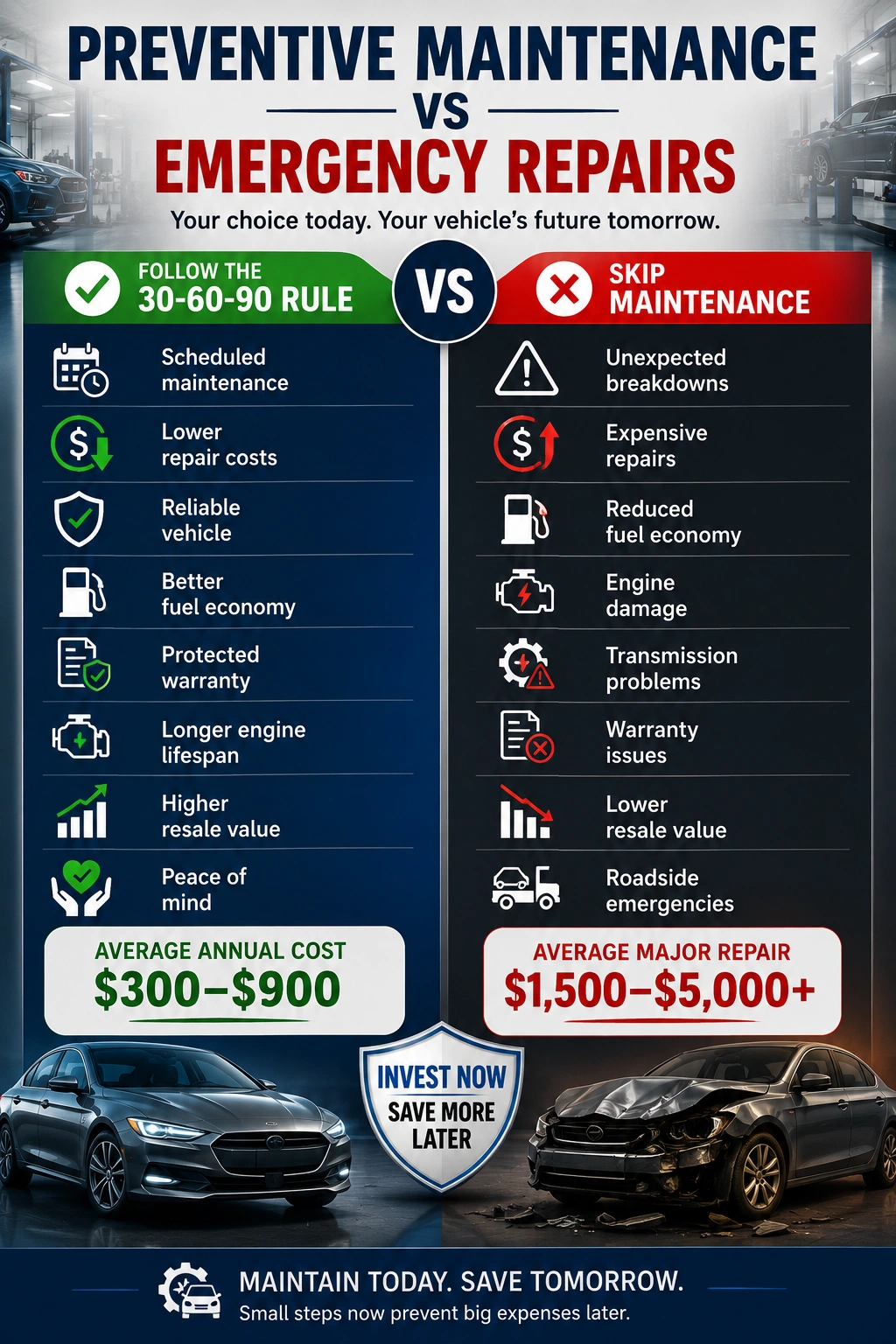
New Technologies and Changing Service Needs
Today’s vehicle technology is rapidly changing the rules of maintenance—literally.
Modern cars, especially hybrids, EVs, and connected vehicles, may adjust or extend service intervals thanks to advanced monitoring and smarter components.
For example, some electric cars require fewer fluid changes but demand regular battery system checks, while connected vehicles use telematics to send maintenance alerts directly to your phone.
- Manufacturer apps now track milestones and send digital reminders at just the right time.
- Digital service records automatically log your history, making it simple for both you and your mechanic to stay on track.
Picture this: Your car reminds you it needs service before you even notice a problem—no more forgetting those critical checkpoints.
How Trusted Auto Service Shops Support the 30-60-90 Rule
Expert auto shops like Auto Clinique play a key role in helping drivers navigate these updates.
- Transparent advice on what your specific make and model needs—never more or less.
- Personalized plans for complicated systems, including hybrids, EVs, and older models.
- Honest guidance about when a service is truly required or if you can safely wait.
A trusted service partner means you don’t just get maintenance—you get peace of mind.
“We prioritize quality repairs that stand the test of time—and only recommend what you need, when you need it.”
Integrating Current Trends and Dallas Market Insights
In Dallas, preventive maintenance is growing in popularity—with nearly 70% of owners following recommended service intervals as of 2023.
- Average costs: Expect $180–$400 for 30k service, $350–$650 at 60k, and $450–$900 for 90k, depending on vehicle type and required parts.
- Local drivers favor transparent scheduling and digital reminders—matching the rise in connected car adoption.
Looking ahead to 2025–2026, expect:
- Regulatory changes to push digital service documentation for warranty protection
- More manufacturers updating interval recommendations based on real-world driving data
For Dallas drivers, the smartest move is simple: consult with a trusted local expert who understands both your car’s needs and the unique North Texas driving environment.
When you stay informed, work with transparent professionals, and embrace new tech, you keep your car (and your life) running smoothly for years to come.
For a broader understanding of vehicle maintenance, repair planning, and long-term ownership costs, explore our comprehensive guide to DIY Auto Repair . It complements the 30-60-90 Rule for Cars Dallas by helping you decide when a repair is suitable for DIY and when expert service is the smarter investment for protecting your vehicle.
Conclusion
Choosing the 30-60-90 rule isn’t just about staying on schedule—it’s your blueprint for peace of mind, predictable costs, and a vehicle that’s always ready for Dallas roads.
By making maintenance proactive rather than reactive, you protect your investment and avoid the stress of surprise repairs. This simple routine is the difference between worry-free commutes and costly breakdowns.
—
Here’s how you can make the 30-60-90 rule work for you right now:
- Mark your next milestone: Write down your upcoming 30k, 60k, or 90k service date on your calendar or phone.
- Review your owner’s manual: Double-check what your make and model need, so you’re only paying for what’s necessary.
- Track every service: Keep records (paper or digital) to support resale value and warranty coverage.
- Partner with a trusted shop: Choose an auto service provider known for quality and transparency—like Auto Clinique.
- Request a personalized plan: Ask your mechanic for maintenance tailored to your Dallas driving habits and unique vehicle.
—
Ready to take the next step?
- Schedule a maintenance checkup—especially if you’re nearing a mileage milestone.
- Set a reminder for your next interval so important services never slip.
- Bring your questions to a professional—never hesitate to ask what’s truly required for your vehicle.
—
Because the best way to drive with confidence isn’t just about fixing problems—it’s making sure they never happen. Give your car the attention it deserves, and enjoy every mile with total peace of mind.
“A well-cared-for car rewards you with reliability, safety, and freedom—mile after mile.”
FAQs
1. What is the 30-60-90 Rule for Cars Dallas?
The 30-60-90 Rule for Cars Dallas is a preventive maintenance schedule that recommends comprehensive vehicle inspections and servicing at 30,000, 60,000, and 90,000 miles. Following these milestones helps improve reliability, reduce repair costs, and extend your vehicle’s lifespan.
2. What services are included in the 30-60-90 Car Maintenance Schedule?
A typical 30-60-90 Car Maintenance Schedule includes oil and filter changes, tire rotations, brake inspections, fluid replacements, spark plug service, transmission maintenance, cooling system inspections, and timing belt or water pump checks (if recommended by the manufacturer).
3. Is the 30-60-90 Rule for Cars Dallas suitable for every vehicle?
Yes, but every vehicle has unique maintenance requirements. While the 30-60-90 Rule for Cars Dallas provides an excellent guideline, you should always compare it with your owner’s manual for model-specific recommendations, especially for hybrids, electric vehicles, and turbocharged engines.
4. How much does a 30-60-90 maintenance service cost in Dallas?
Service costs vary depending on your vehicle and required repairs. In Dallas, a 30,000-mile service typically costs $150–$300, a 60,000-mile service ranges from $350–$700, and a 90,000-mile service may cost $600–$1,200 when major maintenance items are included.
5. Does following the 30-60-90 Rule help maintain my vehicle warranty?
Yes. Following the 30-60-90 Car Maintenance Schedule and documenting all maintenance can help maintain factory warranty coverage, support future warranty claims, and demonstrate proper vehicle care when selling or trading your car.