
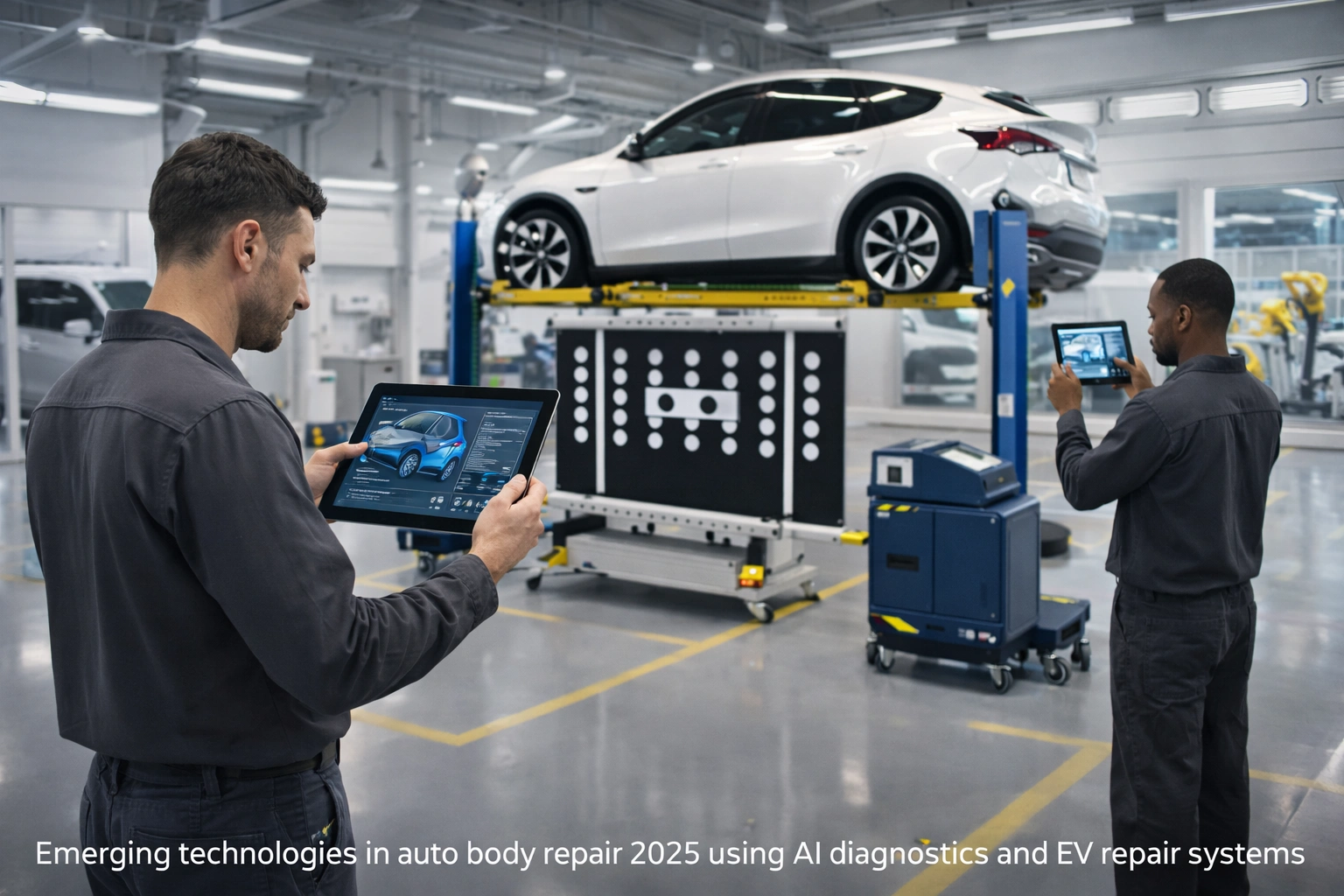
Emerging technologies in auto body repair 2025 are transforming how Dallas drivers experience collision repair—setting new standards for speed, accuracy, safety, and transparency. From AI-powered damage assessments to EV-safe repair systems and robotic refinishing, today’s innovations ensure faster turnaround times, higher-quality results, and greater customer trust.
- AI-driven damage assessment slashes estimate times, with photo-based apps cutting claim cycles by up to 50% and ensuring transparent, data-backed repair plans.
- Robotics and automation deliver flawless results, enabling 30–40% faster repairs through automated paint booths, precision welding, and seamless shop integration.
- AR-powered training and real-time guidance boost technician accuracy, providing step-by-step overlays and live support for even the most complex repairs.
- Advanced materials demand specialized tools, with aluminum- and composite-specific bays and methods like pulse and cold repair increasing safety and speeding cycle times by up to 30%.
- EV and ADAS technologies require certified expertise, with shops investing in EV-safe equipment, automated calibration, and digital compliance logs to ensure customer safety and trust.
- Next-gen paint and coatings set a new bar for finish quality, with self-healing, hydrophobic, and nano-ceramic options reducing follow-ups by 30% and ensuring lasting showroom shine.
- 3D printing accelerates custom part sourcing, allowing shops to fabricate components same-day and cut hard-to-source parts costs by up to 40%.
- Integrated digital systems drive true transparency, empowering customers with live updates, documented repair stages, and traceable estimates at every step.
By embracing these innovations, Dallas-area shops—and their customers—experience faster, safer, and higher-quality repairs with total peace of mind. Dive into the full article to see how these trends can benefit your next repair or upgrade your business for lasting success.
Introduction
Imagine watching a technician use a tablet to scan your car’s bumper after a fender bender—within minutes, you receive a detailed, transparent repair estimate powered by advanced AI. That’s not science fiction; it’s the new reality for Dallas drivers as over 60% of auto body shops plan to adopt breakthrough technologies by 2025.
Today’s vehicle owners want more than just reliable repairs—they expect lightning-fast turnarounds, crystal-clear pricing, and repairs that restore their vehicle well beyond showroom standards. Whether you drive a classic sedan, a modern EV, or an SUV packed with sensors, the demand for precision and transparency has never been higher.
Keeping up with this pace means knowing what’s on the horizon. Emerging technologies are transforming every step of the repair process, offering benefits that matter to you:
- AI-powered diagnostics slash claim and repair times
- Robotic automation delivers flawless finishes with fewer errors
- Materials science and 3D printing make once-unthinkable repairs quick and cost-effective
- Advanced EV and ADAS procedures safeguard your investment and your family
The shops leading the way are focused on more than just gadgets; they use smart tech to stand behind their promise of quality craftsmanship, honest pricing, and customer-first service. For Dallas drivers, this means not only safer cars, but an experience that’s truly stress-free—from estimate to final polish.
So, what exactly is changing, and how will it affect your next repair? From digital damage assessment to eco-friendly coatings, get ready to see how tomorrow’s shop floor is reshaping the standard for care and trust—starting with the evolution that’s happening right now.
The Evolution of Auto Body Repair: Why Emerging Technologies Matter
Customers today expect seamless repairs, transparent pricing, and finishes that restore their cars to showroom quality.
Auto body shops are adapting fast—2025 will see over 60% of shops investing in new tech, according to industry surveys.
Shops that once relied on manual craftsmanship are now powered by digital diagnostics, AI, and advanced materials.
What’s Driving the Change?
Three factors push innovation in the auto body industry:
- Customer Expectations: Owners want accurate estimates, fast turnaround, and lifetime repair quality.
- Modern Vehicle Design: New vehicles use aluminum, high-strength steel, and composites that require specialty repair methods.
- Environmental Standards: Regulations now favor waterborne paints and energy-efficient processes, with some states cutting allowable VOC emissions by up to 90%.
Picture this: A car comes in for a bumper repair. Using a tablet, the technician scans the damage—AI-powered software instantly connects to OEM specs, plans the repair, and gives the customer a transparent, itemized quote in minutes.
From Traditional to Tech-Powered Workflows
Emerging tools are reshaping every phase of auto body work:
- AI-Based Damage Assessment: Photo-based apps and mobile estimating cut claim processing time by more than 50%.
- Digital Measurement and Laser Frame Systems: Ensure repairs meet precise factory tolerances—no more guesswork.
- Automated Paint Booths: Deliver color matches and consistent finishes, reducing rework and maximizing output.
This tech-driven workflow means faster repairs, fewer errors, and more informed customers.
Aligning Technology with Core Values
Innovation isn’t just about new gadgets.
Every breakthrough directly supports these values:
- Quality That Endures: Automated and digital tools guarantee structural strength and flawless finishes.
- Transparent, Honest Service: Digital estimates and repair tracking put customers in control.
- Customer-Centric Care: Faster turnarounds and clearer updates mean happier drivers.
“Your car deserves repairs that are safer, stronger, and more reliable than ever—powered by technology, backed by people you trust.”
As 2025 approaches, the best shops combine expert craftsmanship with the latest tech for unmatched precision and service.
Upgrading your tools isn’t just an investment in equipment—it’s a commitment to providing next-level care and exceeding today’s customer demands.
AI and Digital Diagnostics: Redefining Damage Assessment
The Power of AI in Modern Body Shops
Picture this: You upload a few high-quality photos of your damaged vehicle to a secure shop system and receive a detailed repair estimate within minutes.
This is the reality for Dallas drivers thanks to AI-driven damage assessment tools.
These platforms analyze images, cross-reference thousands of real repair cases, and instantly generate accurate repair plans.
- AI estimate systems can cut claim cycle times by up to 50% compared to traditional manual methods.
- The combined effect? Faster approvals, streamlined repair planning, and transparent communication for every customer.
“Now, every estimate is backed by both experience and hard data—it’s like having a team of experts on call 24/7.”
Seamless Integration: Data, Accuracy, and OEM Precision
Today’s body shops are integrating digital diagnostics and measurement tools for unmatched repair precision.
This means AI doesn’t just stop at estimating—it connects directly to OEM databases and advanced measurement systems, so no detail is left to chance:
- Laser frame measuring and jig/bench setups capture vehicle structure down to the millimeter
- Digital blueprints and repair diagrams are accessible by technicians and insurers, standardizing repair quality
When a repair is based on data from the vehicle manufacturer and laser-measured for accuracy, shops minimize the risk of missed or hidden damage.
“Standardized, OEM-level accuracy is the new customer baseline—millimeter matters in every repair.”
Real-World Impact: Faster, Smarter, More Transparent Repair
For customers, the benefits are immediate:
- Shorter wait times for both estimates and actual repairs—often slashing approval delays by days
- Total transparency throughout the repair, with visual documentation, before-and-after scans, and shareable status updates
- Minimized risk of missed damage, helping avoid costly surprises later
Shops using these technologies have reported a 10-15% drop in rework rates and consistently higher customer satisfaction scores.
“Imagine seeing every stage of your repair, from AI-powered assessment to millimeter-perfect finish—all in one place.”
For anyone who cares about speed, accuracy, and total peace of mind, AI and digital diagnostics set a new standard for auto body repair in 2025.
The most actionable move? Choose a shop embracing these smart systems—you’ll see the difference from your very first estimate.
OEM repair standards
https://www.oem1stop.com
Automation, Robotics, and AR in the Repair Process
Automation is redefining every step in modern auto body shops, moving beyond manual methods into a world of precision and consistency.
Today’s repair centers are investing in systems that automate paint application, sanding, and even weld processes, transforming time-consuming steps into seamless, trackable workflows.
The Rise of Advanced Robotic Systems
Picture this: a robotic arm gliding over a vehicle, applying a flawless coat of paint in record time.
Robotic solutions are now standard for:
- Precision spray painting—evenly coating surfaces, reducing overspray, and cutting material waste
- Automated seam sealing for consistent weatherproofing and structural protection
- Structural alignment and welding—robots handle millimeter-level accuracy, reducing rework and ensuring safer repairs
Case studies show that shops using robotic paint booths and welders have cut repair cycle times by 30–40%, while slashing error rates and warranty rework.
Augmented Reality: Training and Real-Time Repair Guidance
Augmented reality (AR) is no longer just a demo at trade shows—it’s a practical tool for day-to-day work.
AR headsets deliver:
- Real-time OEM repair procedure overlays right onto the car, helping techs visualize each step
- Step-by-step training modules and live remote support for complex repairs or new materials
- On-the-spot measurement and alignment assistance, reducing setup time and minimizing human error
Imagine: a technician adjusts a fender while AR glasses project diagram lines and torque readings directly over their field of view—making complex jobs as straightforward as following a recipe.
Integration and Shop Impact
Complete shop integration is becoming the norm.
- Robotics link to digital repair plans and connected management systems, ensuring traceability and accountability for every action
- Automated mixing and booth controls lock in proper settings for every vehicle, supporting color-matched, eco-friendly finishes without manual guesswork
Leading Dallas-area shops report repair throughput increases up to 25% and a consistent boost in customer satisfaction from improved finish quality.
Curious about the pace of change? These solutions are now rolling out in mainstream shops, not just luxury dealerships or overseas giants. Shops prioritizing automation, AR, and robotics stay ahead by promising results like faster turnaround, flawless finishes, and zero-surprise estimates—all values that Dallas drivers can trust. Ready to experience the future of auto body repair? The future is already at your neighborhood repair center.
Materials Revolution: Repairing Modern Automotive Structures
The cars rolling into shops today are built with aluminum, high-strength steel, and carbon-fiber composites—a dramatic shift from the steel panels of the past.
Repairing these advanced materials requires more than just experience; it demands specialized tools and techniques engineered for precision.
Specialized Tools and Dedicated Work Zones
Shops now use:
- Aluminum-only bays to prevent cross-contamination and ensure warranty compliance
- Separate toolkits for steel, aluminum, and composite repairs
- Purified air systems to keep debris and sparks at bay
This setup helps uphold manufacturer safety standards and boosts both repair quality and speed.
“Picture this: a Dallas auto shop with gleaming yellow-accented bays, each tailored for exact material requirements.”
Pulse, Cold Repair, and Advanced Bonding Methods
Non-traditional approaches lead the way in minimizing heat and metal fatigue:
- Pulse and cold repair systems: Gently reshape panels without high heat, preserving coatings and strength
- Composite bonding and structural adhesives: Replace welding in many cases, producing joints as strong—or stronger—than the original
- Shops report up to 30% faster cycle times by deploying these methods
“Modern adhesives and bondings make tough repairs cleaner, quicker, and safer—no sparks, no stress.”
3D Printing: Rapid Customization and Cost Savings
3D printing is transforming the parts supply chain:
- Fabricate custom brackets, clips, and low-volume exterior parts in hours
- Slash parts wait times from days to same-day completion
- Eliminate costly delays for hard-to-source components
For example, Dallas shops using 3D printing cut parts ordering costs by up to 40% year-over-year.
Takeaway: Modern Materials, Modern Tools
Today’s body repair demands dedicated spaces, specialized equipment, and new repair science.
If your shop isn’t set up for structural aluminum or composite work, you risk falling behind—both in safety and customer expectations.
The era of one-size-fits-all repairs is over; precision craftsmanship and smart tech are now the gold standard for auto body integrity.
EV and ADAS Repair Technologies: Meeting the Demands of the 2025 Car
Safe EV Repair: New Rules, New Risks
Repairing electric vehicles (EVs) in 2025 means following strict safety protocols.
Picture this: every EV in your shop needs high-voltage isolation procedures, specialized tools to disconnect battery packs, and workspace separation for fire safety—it’s non-negotiable.
Shops now require:
- Technician certifications in EV safety (I-CAR, OEM-specific programs)
- Insulated tools and gloves for battery work
- Dedicated EV-only bays to minimize cross-contamination and risks
“One wrong move can jeopardize a technician’s safety and a six-figure car—EV expertise is now a must.”
ADAS Recalibration: Accuracy Is Everything
ADAS-equipped vehicles—think cameras, radar, and lidar—require recalibration any time sensors or windshields are touched.
For 2025, shops are investing heavily in:
- Automated calibration bays with laser positioning
- Integrated wheel alignment systems for sub-millimeter accuracy
- Software that stays updated with the latest OEM specs
These tools can cut ADAS setup time from forty-five minutes to under ten, helping vehicles get back on the road safely—and meeting insurance standards.
Compliance, Training, and Customer Trust
You can’t just “wing it” with today’s advanced vehicles.
Auto repair shops must document:
- Technician training records
- Safety procedures and compliance logs
- Manufacturer-approved repair and calibration steps
Customers and insurers both demand transparency. Expect more digital reports and pre- and post-repair scans as part of the claims and documentation process.
“With real-time calibration reports, customers see exactly how their safety features are restored—no mysteries, just proof.”
Dallas Shops Leading the Way
Local shops embracing early adoption report:
- Reduced claim turnaround times—sometimes by days
- Fewer warranty reworks thanks to automated calibration and documentation
- Customers saying, “I trust my car is truly repaired, not just patched up”
Picture a technician using an AR headset to confirm camera alignment, while a customer gets a live update on their phone.
“Quality isn’t just what you see—it’s every step behind the scenes that protects your investment and family.”
The heart of next-generation auto repair is combining safety, accuracy, and transparency. Shops prepared for EV and ADAS service will not only pass every certification check—they’ll set the new customer standard for Dallas or any city in 2025.
Next-Generation Paintless Dent Repair (PDR)
Paintless dent repair has undergone a seismic shift for 2025, thanks to advanced materials and evolving vehicle designs.
Today, PDR must tackle:
- Aluminum panels and carbon-fiber bodies that demand specialized expertise
- Tight access zones in EVs and modern vehicles, such as roof rails and double-wall structures
- A growing focus on fast turnaround for both hail damage and everyday repairs
Precision Starts With Advanced Lighting
Ultra-bright LED reflection boards and next-gen mapping tools are now essential.
They:
- Reveal even minor dents and crease lines, making invisible damage instantly visible
- Enable more accurate dent identification, node mapping, and technician documentation
Picture this: An LED board highlights a subtle dent under harsh shop lights, showing detail you’d otherwise miss. It’s a visual difference you can literally see on camera or in demo videos.
Sophisticated Tools for Complex Dents
Next-gen PDR relies on a toolbox designed for today’s vehicle challenges:
- Flexible, high-strength PDR rods and tips engineered for aluminum, soft, and precision use
- Heated and electromagnetic tips to safely shape and relax metal—even in sensitive EV structures
- Glue-pulling systems for spots with no backside access, now stronger and more reliable than ever
“Modern glue-pullers make repairing tricky EV dents not just possible, but routine.”
Magnetic Induction: The Non-Invasive Edge
Magnetic induction and electromagnetic heating now let techs reshape metal with minimal risk.
- Creates heat inside the panel, reducing paint damage risks
- Especially effective for hail dents and areas with coatings that can’t take high temperatures
For customers, this means repairs are safer, faster, and less intrusive.
Digital Documentation and Certification
Today’s PDR shops lead with transparency and professionalism:
- Digital imaging and before/after documentation now standard for insurers and customers alike
- Many techs use tablet-based systems for PDR logs, estimate sharing, and instant approval
Training is keeping up, too—with:
- Multi-material, EV-safe certification programs now widely offered
- Specialized hail courses promising cycle times up to 30% faster than older methods
Setting the Standard in Modern Dent Repair
Next-gen PDR means less downtime, safer repairs, and better documentation—all with minimal intrusion.
“Smart shops use advanced tooling and digital records to earn trust and set higher standards.”
For drivers and shops alike: faster fixes, lasting results, and total peace of mind—that’s the new norm in PDR for 2025.
Breakthroughs in Paint, Coating, and Surface Technology
Next-Gen Coatings: Self-Healing, Hydrophobic & Nano-Ceramic
Imagine leaving a light scratch in your driveway—yet watching it “heal” under a sunny Texas afternoon.
Smart coatings are making this a reality with:
- Self-healing clear coats that erase minor scratches and swirl marks when exposed to heat
- Hydrophobic finishes that repel water and resist grime, making car washes almost optional
- Nano-ceramic coatings for the ultimate in chemical and UV protection
Shops implementing these finishes report up to 30% fewer follow-up appointments due to finish complaints. This technology keeps Dallas vehicles looking showroom-new, even in tough city conditions.
Eco-Friendly Refinish: Cleaner, Greener, Better
Shifting regulations and eco-conscious customers are driving a change:
- Waterborne paint systems slash VOC emissions by up to 90% compared to solvent options
- Lower bake temperatures mean faster curing times and lower energy bills
- Advanced systems are now standard, not just premium—helping shops meet local air quality requirements
“Switching to waterborne paints means healthier teams and a safer community. That’s quality you can trust.”
Precision Color Matching & Automated Quality
Color-matching technology has reached new heights for flawless repairs:
- Spectrophotometers measure exact paint codes and vehicle shades, reducing mismatches
- Automated mixing systems prep paint with near-zero human error
- Smart booth controls constantly monitor temp, humidity, and particulates for consistency
These upgrades lead to:
- Durable finishes that outperform factory paint in gloss and longevity
- Curing times cut by 25-40% versus previous tech
Picture this: A customer’s classic red coupe rolls out of the booth—color-perfect, ready the same day, with zero overspray or ghosting.
Real Impact: From Shop Floor to Customer Experience
By embracing advanced surface technology, top repair centers now deliver:
- Finish durability that lasts years, not just months
- Customer satisfaction scores jump 15-20% after implementing smart coatings and digital color matching
- Greener operations that use less energy and fewer harmful chemicals
When finish quality matters, these breakthroughs don’t just keep you competitive—they turn first-time visitors into lifelong customers.
In today’s market, embracing smart coatings, waterborne systems, and automated precision isn’t just about tech—it’s about exceeding expectations, every single time.
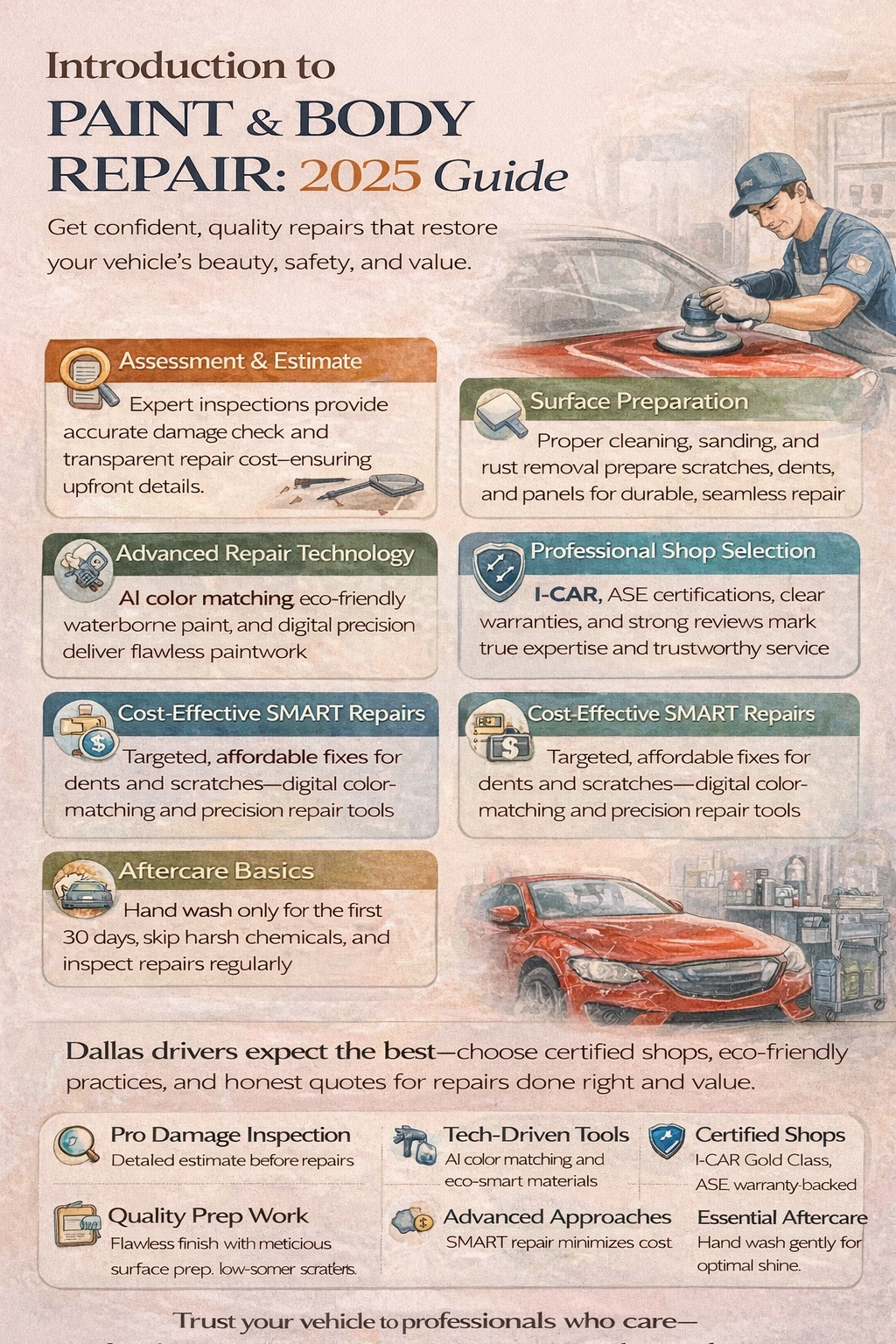
Essential 2025 Technologies for a Competitive Repair Shop
Staying competitive in 2025 means investing in tools and processes that set your shop apart.
Customers now expect not just a fix, but fast answers, clear estimates, and modern communication—making tech your frontline teammate.
Must-Have Investments: What Sets Leading Shops Apart
Picture this: A new vehicle rolls in, and your team instantly creates a precise repair plan using an AI-driven tablet scanner.
To meet today’s standards, top Dallas shops are prioritizing:
- AI estimating and blueprinting platforms for instant, data-driven assessments
- ADAS calibration bays with laser alignment for systems like lane-keeping and emergency braking
- EV repair tooling: high-voltage isolation equipment and battery-safe lifts
- 3D printing capabilities for custom brackets, trim, and faster parts sourcing
- Augmented reality (AR) headsets and laser measurement tools to boost accuracy and guide technicians
These upgrades don’t just make you look high-tech—they directly cut repair cycle times and rework.
Technician Upskilling: Your People, Powered Up
The technology is only as good as the team using it.
Smart shops now build in regular training on:
- Modern paintless dent repair (PDR) techniques with advanced LED mapping
- Safe handling and repair of aluminum, carbon fiber, and high-strength steel
- EV diagnostics and service certifications
- Fast, reliable ADAS system calibration to manufacturer standards
“Technicians trained on tomorrow’s tech deliver repairs that last and impress.”
Transparent Operations and Value-Driven Upgrades
Customers trust shops using integrated management systems that track every step and power honest pricing.
Try these actionable tips:
- Prioritize investments by job volume and customer demand—don’t chase fads
- Lean into upgrades that align with your shop’s core values—quality and transparency
- Use shop data to identify bottlenecks and where the right tech makes the biggest difference
Real-World Dallas Success and What’s Next
Shops across Dallas that adopt new tech have reduced repair times by up to 30% and report higher customer ratings.
“Imagine your next customer tour: big screens show job status, AI highlights hidden damage, and every estimate is backed by digital proof.”
The next wave? Expect tech that’s even more customer-facing—live repair tracking, instant messaging, and seamless insurance claims.
The lesson: Investing in proven technology and upskilling your team is the fastest path to delivering quality that speaks for itself.
Conclusion
Embracing the latest technologies in auto body repair is about more than keeping up—it’s about delivering the safest, highest-quality, and most transparent service for your customers. By investing in smart systems and upskilling your team, you shape a repair experience that’s built on trust, precision, and efficiency.
Key Takeaways:
- Adopt AI diagnostics and digital repair tools to cut turnaround times and guarantee accurate estimates.
- Prioritize technician training for EVs, ADAS calibration, and advanced materials—skills that attract loyal customers and set your shop apart.
- Invest in eco-friendly paint and modern finishes for results that last and refinishing processes that protect both people and the planet.
- Leverage automation and AR tools to improve workflow, minimize errors, and create a seamless customer journey.
- Commit to transparent pricing and digital documentation, ensuring every customer feels in control and informed at every step.
Here’s how you can take the lead today:
- Audit your current tools and workflows—identify gaps where new tech could deliver faster, safer outcomes.
- Schedule upskilling sessions so your technicians are certified and confident with tomorrow’s vehicle and material challenges.
- Upgrade your customer communications by offering digital repair updates, live estimates, and before/after documentation.
- Partner with suppliers committed to sustainable paints and parts, aligning your shop with what matters most to Dallas drivers.
Fusing innovation with care is how you maximize every repair—not just for the cars in your shop, but for the people who rely on them. “Quality repairs powered by technology aren’t just the future—they’re the new standard. Your next move sets you apart.”
Drive your business forward with confidence. The advantage belongs to those who act boldly—and build trust with every job.
Learn how our shop applies emerging technologies in auto body repair 2025 through our advanced collision repair and ADAS calibration services.
FAQs
1. What are emerging technologies in auto body repair 2025?
Emerging technologies in auto body repair 2025 include AI-driven damage assessment, robotic paint systems, EV-safe repair tools, ADAS calibration technology, 3D printing for parts, augmented reality (AR) technician guidance, and advanced eco-friendly coatings. These innovations improve repair accuracy, safety, speed, and transparency.
2. How do emerging technologies in auto body repair 2025 benefit vehicle owners?
Emerging technologies in auto body repair 2025 benefit vehicle owners by reducing repair time, improving estimate accuracy, enhancing safety for EV and ADAS-equipped vehicles, and providing real-time repair updates. Customers experience fewer delays, clearer pricing, and higher-quality, longer-lasting repairs.
3. Are emerging technologies in auto body repair 2025 required for EVs and modern cars?
Yes. Emerging technologies in auto body repair 2025 are essential for repairing electric vehicles (EVs) and ADAS-equipped cars. These vehicles require high-voltage safety tools, automated sensor calibration, OEM-certified procedures, and digital documentation to ensure proper functionality and driver safety.
4. Do emerging technologies in auto body repair 2025 reduce repair costs?
While some advanced tools require upfront investment, emerging technologies in auto body repair 2025 often lower overall costs by reducing rework, minimizing human error, shortening repair cycles, and preventing future failures—saving both shops and customers money long term.